ARTIFICIAL INTELLIGENCE
Artificial Intelligence (AI) introduces students to the concepts, techniques, and technologies used to develop computer systems capable of performing tasks that normally require human intelligence. The course covers intelligent agents, problem solving, knowledge representation, machine learning, expert systems, natural language processing, computer vision, robotics, generative AI, and the ethical and responsible use of AI.
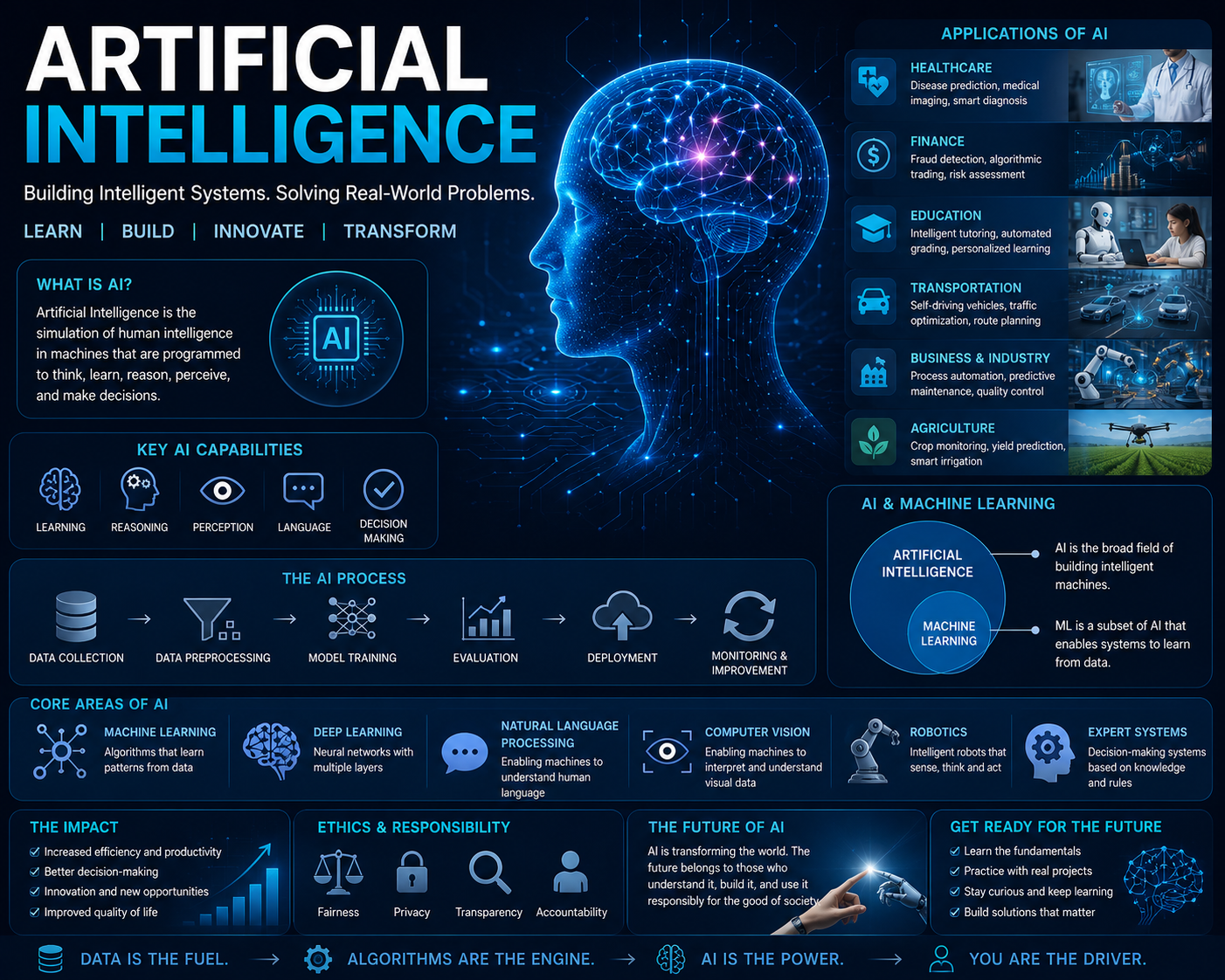
Artificial Intelligence (AI) is a comprehensive course unit designed to introduce students to the principles, techniques, technologies, and practical applications involved in developing intelligent computer systems. The course examines how computers can be designed to perform tasks associated with human intelligence, including learning, reasoning, problem solving, perception, language understanding, decision-making, and adaptation.
Students begin by studying the foundations and evolution of Artificial Intelligence, including the meaning of intelligence, characteristics of intelligent systems, major milestones in AI development, different categories of AI, and the relationship between Artificial Intelligence, Machine Learning, Deep Learning, Data Science, and Generative AI.
The course introduces intelligent agents and problem-solving techniques, examining how AI systems perceive their environments, evaluate possible actions, and make decisions. Students explore state-space representation, search strategies, heuristics, optimization techniques, and other approaches used by intelligent systems to solve computational problems.
An important component of the course is knowledge representation and reasoning. Students learn how knowledge can be represented using rules, logic, semantic structures, knowledge bases, and other computational approaches. This provides a foundation for understanding expert systems, including their major components such as the knowledge base, inference engine, user interface, and explanation facility.
The course also introduces Machine Learning, where students examine how computer systems can learn patterns from data rather than relying entirely on explicitly programmed rules. Major approaches including supervised learning, unsupervised learning, and reinforcement learning are discussed together with practical applications such as classification, prediction, clustering, recommendation, and decision support.
Students are introduced to Artificial Neural Networks and Deep Learning, examining how computational models inspired by biological neural systems can learn complex patterns from large datasets. Practical applications in image recognition, speech processing, prediction, and modern generative AI systems are explored.
The course further examines major areas of AI including Natural Language Processing (NLP), Computer Vision, Speech Recognition, Robotics, Autonomous Systems, Recommendation Systems, and Generative Artificial Intelligence. Students explore how these technologies enable computers to understand language, interpret images and video, interact conversationally, generate new content, and operate intelligently within physical environments.
Contemporary Generative AI and Large Language Models (LLMs) are also introduced, enabling students to understand technologies behind modern AI assistants and content-generation systems. Topics include prompting, AI-generated text and images, hallucinations, model limitations, responsible use, and the changing relationship between humans and intelligent computing systems.
Considerable attention is given to the real-world application of Artificial Intelligence. Students examine AI applications in areas such as healthcare, education, agriculture, banking and finance, cybersecurity, transportation, manufacturing, business, government, telecommunications, e-commerce, and scientific research, with examples relevant to Uganda, Africa, and the wider global environment.
The course critically examines the ethical, legal, security, and social implications of AI, including algorithmic bias, fairness, privacy, misinformation, intellectual property, transparency, explainability, accountability, employment displacement, cybersecurity, and responsible AI governance. Students are encouraged to consider not only what AI systems can do, but also what they should be allowed to do and how humans should remain accountable for their use.
Through theoretical study, demonstrations, case studies, practical exercises, and AI-based projects, students develop both a conceptual and practical understanding of intelligent systems.
By the end of the course, students should be able to explain fundamental AI concepts, distinguish major AI techniques, understand how intelligent systems learn and make decisions, identify appropriate AI solutions for real-world problems, evaluate the benefits and limitations of AI technologies, and apply principles of ethical and responsible Artificial Intelligence.
Course Outline (Weekly)
| Week | Topics |
|---|---|
| Course outline will be available soon. | |